by Carolina Cunha, Veterinarian, DVM, MSc, Product Executive, CF Pharma VET
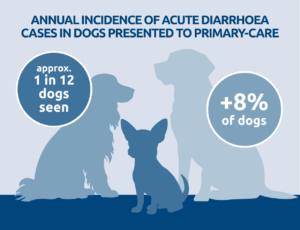
Acute diarrhoea is one of the most frequent reasons dog and cat owners seek veterinary care in the UK and Ireland. Primary-care data estimate an annual incidence of just over 8% in dogs alone,¹ making it a daily fixture in small animal practice.
Most cases are uncomplicated and self-limiting, resolving within a few days. Yet the way we manage them has changed considerably over the past decade, driven by a stronger evidence base, growing concern over antimicrobial resistance, and a richer understanding of the gut microbiome and its role in recovery.
The challenge for clinicians today is not identifying that change is needed – the evidence is clear. It is keeping pace with what that change looks like in practice, and understanding the science behind the tools now available.
The antimicrobial problem: What the evidence actually shows
For many years, antimicrobials were a default component of acute diarrhoea management. The rationale seemed intuitive – infection is a plausible cause, antibiotics eliminate bacteria, therefore antibiotics should help. The data, however, tell a different story.
Large-scale UK primary-care studies have found that antimicrobials were prescribed in a substantial proportion of cases despite limited diagnostic investigation and no evidence of systemic illness.² More than 95% of cases resolve regardless of antimicrobial use.² Causal-inference analyses using target-trial emulation methodology have since confirmed that antimicrobial prescription at first presentation does not improve clinical resolution compared with supportive care alone.³
Both ENOVAT and WSAVA now explicitly recommend against routine antimicrobial use in systemically well patients, reserving these agents for cases with fever, signs of systemic compromise, or confirmed bacterial pathogen identification.4,5 It is also worth addressing a common clinical reflex: the presence of blood in the stool does not, in itself, constitute an indication for antimicrobial therapy. Haematochezia in an otherwise systemically well patient most commonly reflects acute haemorrhagic diarrhoea syndrome (AHDS) or self-limiting colitis – conditions for which the evidence does not support routine antimicrobial use.3,4,5 Antimicrobials remain appropriate where there is genuine concern for bacterial translocation or sepsis – signalled by fever, leucocytosis, haemoconcentration, or cardiovascular compromise – not simply on the basis of blood in the faeces alone.
Triage, early feeding, and microbiome support
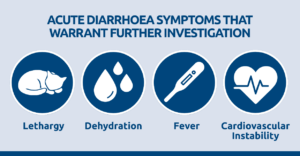
Sound triage remains the foundation of appropriate management. Animals that are bright, alert, normothermic, and well-hydrated are candidates for outpatient supportive care. Those showing lethargy, dehydration, fever, or cardiovascular instability warrant further investigation.4,5
Fasting, once routine, is no longer supported by evidence. Early enteral nutrition maintains enterocyte energy supply, supports mucosal barrier function, and prevents the protein catabolism associated with prolonged food restriction.⁶ A highly digestible, low-fat diet is preferred: fat stimulates cholecystokinin release and can exacerbate pancreatic inflammation, which matters both where pancreatitis is on the differential and in the broader acute GI patient.⁷
Disruption of the gastrointestinal microbiota is now recognised as both a consequence and a driver of acute diarrhoea. Dysbiosis impairs colonisation resistance, amplifies mucosal inflammation, and delays recovery.⁸ This has shifted management from symptom suppression toward active microbiome support.
Postbiotics: Moving beyond the ‘Dead Bacteria’ scepticism
Postbiotics are perhaps the most misunderstood component of modern gut support formulations. The objection is common: if probiotics work through live bacteria, how can inactivated ones do anything useful? It is a fair question, but the answer is more interesting than the scepticism allows.
The ISAPP formally defined postbiotics in 2021 as preparations of inactivated microorganisms and/or their components that confer a health benefit on the host.⁹ When bacterial cells are heat-inactivated, the cell wall remains structurally intact. Its components, peptidoglycans, lipoteichoic acids, surface proteins, are actively recognised by immune receptors in the gut epithelium, triggering tolerogenic immune responses, supporting tight junction integrity, and modulating the inflammatory environment.¹⁰ʸ¹¹ These are not passive passengers; they interact with the mucosa in measurable, mechanistically coherent ways.
Adsorbent therapy: Bentonite in context
Bentonite (smectite clay) has a well-established role in acute diarrhoea management. Its layered silicate structure binds water, microbial toxins, and inflammatory mediators within the intestinal lumen, reducing luminal fluidity and attenuating mucosal injury.¹⁴ Clinical studies in dogs have demonstrated measurable reductions in severity and duration.¹⁵ Acting non-systemically, it is a low-risk, first-line intervention with a straightforward rationale.
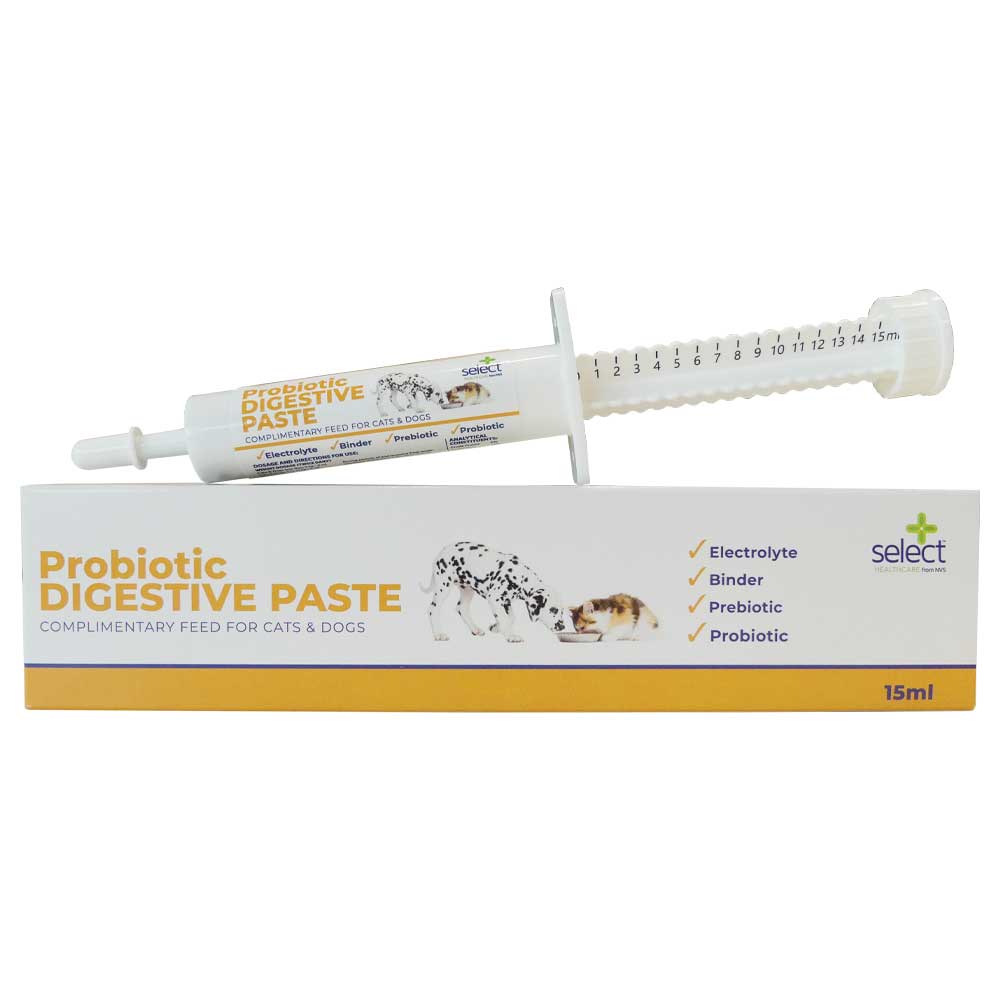
Select from NVS Probiotic Digestive Paste:
A formulation built for modern practice
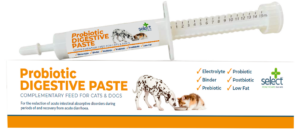
The new formulation of Probiotic Digestive Paste (NVS)
- Bentonite – adsorptive support to reduce luminal toxin load and fluid loss
- Prebiotics – fermentable substrates to promote beneficial microbiota recovery
- Heat-treated probiotic strains (postbiotic effect) – immune modulation and tight junction support
- Electrolytes – replacement of sodium, potassium, and chloride losses
- L-glutamine – principal energy substrate for enterocytes
- Dextrose – readily bioavailable energy for the absorptive mucosa
Clinical application: A practical framework
For the systemically well dog or cat with acute, uncomplicated diarrhoea:
#1. Assess systemic status
Hydration, mentation, temperature, cardiovascular parameters. If abnormal, investigate further.
#2. Do not fast
Initiate early enteral nutrition with a highly digestible, low-fat diet.
#3. Provide multimodal GI support
Adsorbents, electrolytes, gut barrier support, and microbiome-targeting agents.
#4. Avoid routine antimicrobials
Do not prescribe on the basis of haematochezia alone; reserve for confirmed systemic illness.
#5. Reassess at 48–72 hours
Most cases resolve within this window; persistence or deterioration warrants investigation.3,4,5
Conclusion
The shift in acute diarrhoea management reflects a maturation of veterinary internal medicine, one that takes evidence seriously and no longer defaults to antimicrobial prescribing out of habit. Postbiotics are a case in point: mechanistically active, demonstrably safe, and increasingly supported by evidence in companion animal species.
More about the author:
Carolina Cunha, Veterinarian, DVM, MSc, Product Executive, CF Pharma VET

Carolina is a veterinarian with over eight years’ experience in companion and large animal practice, including as a managing partner. Now working in the animal health industry, she brings clinical insight to product development and communication. She understands the importance of shaping products that are relevant to the market, supporting veterinarians in promoting health and improving the lives of companion animals.
Her strong interest in the microbiome enriches the technical and commercial aspects of her work, guiding evidence-based formulation, identifying emerging health trends and supporting strategic product positioning and business development.
The article was originally posted in The Cube magazine, June 2026 issue. Click here to read the magazine.
Related products