
The first year matters more than you think
by Carolina Cunha, Veterinarian, DVM, MSc, Product Executive, CF Pharma VET
Gastrointestinal upset and infectious disease are disproportionately common in the first months of a dog’s or cat’s life — a pattern that reflects the biological vulnerabilities of this developmental window rather than chance. The gastrointestinal tract and the immune system are deeply intertwined in young animals, and what happens in the gut during the first year can shape systemic immunity for years to come. The good news is that this is also a window of genuine opportunity: the right nutritional support, given at the right moment, can meaningfully influence how well a young animal navigates the challenges ahead.
This article explores why the first year is so critical, which animals are most at risk, and which nutritional ingredients have the most credible evidence for supporting the GI-immune axis during early life.
Why the gut is the centre of immunity
The gut is not simply a digestive organ. Gut-associated lymphoid tissue (GALT) is the dominant component of the body’s mucosal immune system and represents approximately 70% of the entire immune system; additionally, around 80% of all plasma cells reside within it (Vighi et al., 2008). In young animals, both the physical barrier and the immunological machinery of the gut are still maturing. The microbiome is being established, the mucosal immune system is learning to tolerate commensals while responding to pathogens, and the epithelial lining is being shaped by early dietary and environmental exposures.
This developmental period creates opportunity — but also vulnerability. Disruptions to the gut during this window, whether from infection, stress, dietary change, or inadequate passive immunity transfer, can have downstream consequences extending well beyond the GI tract. The composition, abundance, and metabolic activity of the gut microbiome are all elements that shape outcomes relating to metabolism and immune function across the life of the animal (Amaral et al., 2024). In dogs specifically, the relationship between gut microbiome composition and long-term immune competence is increasingly well characterised (Pilla and Suchodolski, 2020).
The first year: A perfect storm of risk factors
From a clinical perspective, the first 12 months include multiple unavoidable stressors that converge on the GI tract. Understanding when these windows of vulnerability occur is the first step towards identifying which animals may benefit from targeted nutritional support.
Weaning and dietary transition
The shift from milk to solid food is arguably the most significant nutritional challenge of early life. The gut microbiota undergoes rapid and substantial restructuring during this period — in kittens, significant changes in immune function and microbial communities have been documented within days of weaning (Zhang et al., 2025), and in puppies the microbiota becomes progressively more similar to the adult composition as solid food is introduced (Balouei et al., 2023). Abrupt changes in diet composition or feeding frequency can disrupt this process and impair barrier function. This is one of the most predictable stress windows of the first year — and one where proactive nutritional support has the greatest potential to reduce disruption.
Rehoming and environmental stress
Separation from the dam, transport, novel environments and altered routines all affect gut motility, microbial balance and immune responsiveness. The post-weaning period is associated with increased susceptibility to both infection and GI upset in dogs and cats, with one analysis reporting that 55% of kittens aged one to four months suffered from infectious diseases following rehoming (Gore et al., 2021). For many puppies and kittens, the first days in a new home represent the highest combined GI and immune burden they have yet encountered.
Vaccination and immune activation
Vaccinations occur at a time when maternal immunity is waning and the young animal’s own immune system is still maturing — the very window in which GI health and immune competence are most closely linked. Nutritional support that enhances mucosal IgA and improves vaccine response has been shown to be clinically meaningful at this stage (Gore et al., 2021). Supporting mucosal immunity and gut barrier function during this period is not just about preventing diarrhoea — it is about giving the immune system the best possible foundation from which to respond.
Immature digestive and immune function
Puppies and kittens have lower digestive enzyme activity, reduced secretory IgA production and limited immune memory, making them more susceptible to gastrointestinal upset and infection during the first weeks and months of life. GALT represents approximately 70% of the entire immune system and is the primary interface between nutrition and immunity (Vighi et al., 2008) — which is precisely why what an animal eats during this period matters so much. This is not a pathological state — it is a normal developmental phase. But it does mean that young animals have less physiological reserve when faced with dietary or environmental challenge.
Early medical interventions
Antibiotics, antiparasitics or treatment for neonatal illness may further disturb microbiome development if used during sensitive windows. Even short antibiotic courses in early life can alter microbiome composition in ways that persist for weeks to months (Pilla and Suchodolski, 2020). When such interventions are necessary, concurrent and post-treatment GI support can help preserve the microbiome trajectory that would otherwise be disrupted.
Collectively, these factors explain why gastrointestinal signs such as soft stools or transient diarrhoea are so common in young animals — and why the same animal may experience several of these stressors within a matter of weeks. Each one is manageable in isolation. When they cluster together, as they so often do in the first year, the case for targeted nutritional support becomes compelling.
Which animals are most at risk?
Not all puppies and kittens face the same degree of risk. Certain circumstances substantially increase the likelihood of GI or immune challenges in the first year:
- Neonates from large litters — competition for colostrum can result in inadequate immunoglobulin absorption in smaller or later-feeding littermates.
- Neonates born to primiparous or poorly nourished dams — colostrum quality and quantity are directly affected by maternal nutritional status and health (Chastant et al., 2017).
- Animals rehomed at or shortly after weaning — the combined physiological stress of dietary change, environmental change, and dam separation is a well-recognised precipitant of GI disruption (Gore et al., 2021).
- Rescue and shelter animals — variable histories, unknown vaccination status, and high pathogen exposure make this population particularly vulnerable.
- Animals with a history of antibiotic use — even short courses in early life can significantly alter microbiome composition in ways that persist for weeks to months (Pilla and Suchodolski, 2020).
- Animals born via caesarean section, where normal microbiome seeding from vaginal transit is bypassed (Balouei et al., 2023).
These are not edge cases — many of them describe the majority of puppies and kittens seen in first-opinion practice. They are also the animals for whom a targeted supplement at key transition points makes the most clinical sense: not as a treatment, but as a considered and timely act of prevention.
What owners can do: Practical guidance
Conversations with owners of young animals are most effective when focused on concrete, actionable steps.
Nutrition quality and consistency
A complete and balanced diet formulated specifically for puppies or kittens is the baseline requirement. Consistency matters enormously during the first year. Frequent diet changes, table scraps, and irregular feeding schedules add unnecessary GI challenge during a period when the gut is still adapting. When transitions are necessary, a gradual changeover over seven to ten days minimises disruption.
Stress minimisation during transitions
Where possible, rehoming should be timed thoughtfully. New owners should be prepared for a settling-in period during which appetite and stool quality may be variable. Familiar bedding, consistent routine, and avoiding over-stimulation in the first days at home all help reduce stress-mediated gut disruption. The relationship between stress, immune suppression, and GI disturbance is well established in cats and dogs, and the post-weaning period is a particularly sensitive window (Gore et al., 2021).
Routine preventive healthcare
Vaccination and parasite control are not strictly nutritional issues, but they interact with gut health in important ways. Intestinal parasites are a common cause of chronic low-grade GI inflammation in young animals, and appropriate prophylaxis is part of a holistic approach to GI and immune health. It is worth noting that nutritional support for the immune system may also improve the robustness of vaccine responses, as discussed below.
Targeted nutritional support at key transition points
Beyond baseline nutrition, there are specific moments in the first year where targeted supplementation makes biological sense: at birth or immediately post-weaning when colostrum intake is uncertain, during the stress of rehoming, and in animals recovering from GI disturbance or antibiotic treatment. The ingredient profile of any supplement used during these windows should be matched to the physiological challenges of the moment.
Active ingredients that support the GI-immune axis
The science of gut-immune support in young animals has advanced considerably. Several ingredients now have a credible, species-specific evidence base — but what matters as much as individual efficacy is how these ingredients work together. The four classes below address the GI-immune interface through complementary, mechanistically distinct pathways. Used in combination, they provide a more complete physiological response than any single ingredient could achieve alone.
Colostrum
Bovine colostrum is the most comprehensively studied bioactive supplement for early-life immune support in companion animals. Its primary immunological constituents — IgG, IgA, and IgM immunoglobulins — provide passive immune coverage against a broad range of enteric pathogens. Beyond immunoglobulins, colostrum contains insulin-like growth factors, lactoferrin, and lysozyme, which support epithelial maturation and mucosal defence.
In kittens specifically, dietary supplementation with 0.1% spray-dried bovine colostrum has been shown to increase faecal IgA expression and produce a faster, stronger antibody response to rabies vaccine booster, indicative of both enhanced local and systemic immune function. Bovine colostrum also supported greater stability of the gut microbiota following a mildly stressful life challenge in treated kittens compared to controls (Gore et al., 2021). In dogs, bovine colostrum supplementation has similarly been shown to influence immune function, and the same research group extended this work across life stages (Yu and Satyaraj, 2025).
Beta-glucans
Beta-1,3/1,6-glucans derived from yeast cell walls are well-characterised immunomodulatory compounds. In dogs, these glucans have been demonstrated to induce trained innate immunity through canine macrophages in a mechanism that depends on Dectin-1 receptor engagement, with canine macrophages showing up to a 30-fold increase in TNF-α secretion following immune training with beta-glucan from Euglena gracilis (Paris et al., 2020). This represents canine-specific evidence for the mechanism of action that underpins beta-glucan’s immunological activity.
Beta-glucans also carry prebiotic activity, selectively supporting commensal populations in the large intestine. In kittens, a dietary supplement containing nucleotides alongside oligosaccharides was associated with improved immune responses and favourable gut microbiota changes over 52 weeks (Joly et al., 2025), providing further support for the utility of these ingredients at the gut-immune interface.
Nucleotides
Dietary nucleotides are conditionally essential for rapidly proliferating tissues, including intestinal epithelial cells and immune cells. The demand for nucleotides in young animals is high during periods of rapid growth or GI recovery, when endogenous synthesis may not be sufficient. In kittens, supplementation with nucleotides alongside other functional ingredients significantly influenced immune function over the first year of life compared to controls, with effects on both cellular and humoral immune responses (Atwal et al., 2023; Joly et al., 2025).
Bioactive peptides from hydrolysed plasma
Spray-dried plasma (SDP) has an established evidence base in production animal species and is increasingly studied in companion animals. Its immunoglobulin and peptide fractions act through complementary mechanisms: direct pathogen binding at the intestinal surface, modulation of cytokine release, and support of tight junction integrity. A recent study in adult dogs incorporated SDP into extruded diets and demonstrated effects on nutrient digestibility, fecal metabolites, gut microbiota composition, and immune biomarkers (Mioto et al., 2025). Porcine IgG from SDPP has also been shown to remain functionally active throughout the canine digestive tract, consistent with local mucosal protection.
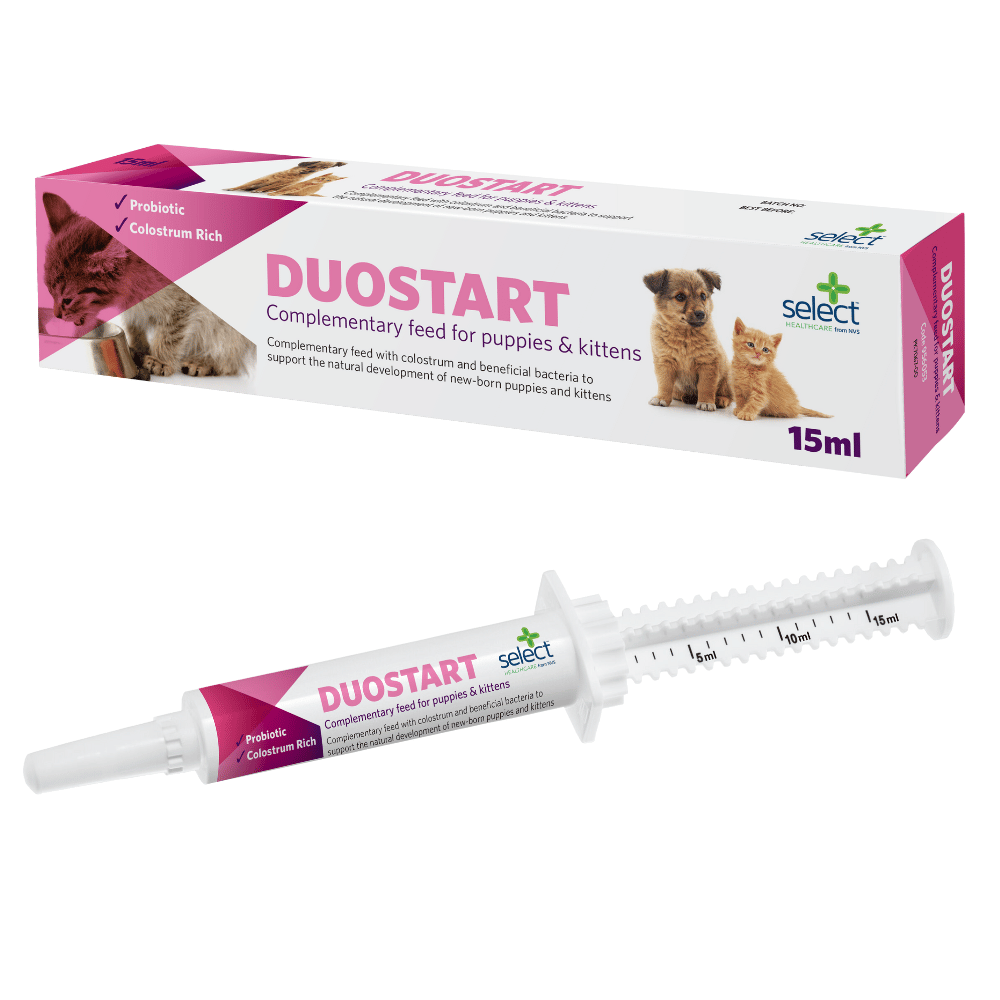
Putting it together: DuoStart
Knowing which ingredients matter is one thing. Having them available in a practical, ready-to-use format — at the moments when they are actually needed — is another.
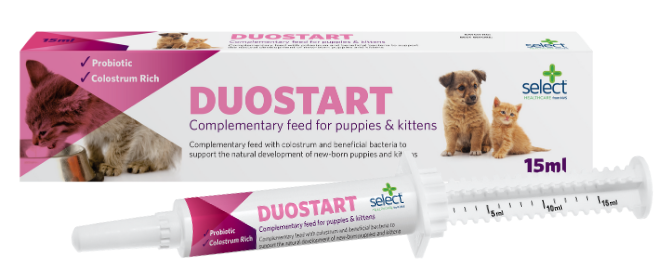
DuoStart brings together bovine colostrum, beta-1,3/1,6-glucans, nucleotides and bioactive peptides from hydrolysed plasma in a single 15 ml syringe, formulated specifically for puppies and kittens. The syringe format is not incidental — it is designed for the reality of early-life care, whether that is a breeder administering support in the first hours after birth, a veterinarian recommending it at the point of rehoming, or an owner managing a difficult weaning transition at home. No preparation, no measuring, no waste.
The moments where DuoStart makes most sense map precisely onto the risk windows described above: at birth or in the neonatal period when colostrum intake is uncertain; at weaning and rehoming when the GI tract and immune system face their greatest combined challenge; around vaccination when mucosal immune support is most valuable; and during or after antibiotic treatment when the microbiome needs active protection. These are not rare or exceptional situations — they are the routine events of the first year of life in dogs and cats.
The first year cannot be repeated. Supporting it well, with the right ingredients at the right moments, is one of the most straightforward and evidence-based recommendations a veterinarian can make for a young animal’s long-term health.
Recommended Dosage
| Species | Body Weight | Dose |
| Puppies & Kittens | <10 kg | 2 ml |
| 10–25 kg | 4 ml | |
| >25 kg | 6–8 ml |
References
Amaral, A.R., et al. (2024) ‘Programming of metabolic and autoimmune diseases in canine and feline: linkage to the gut microbiome’, Microorganisms, 12, 1071.
Atwal, J., Joly, W., Bednall, R., Albanese, F., Farquhar, M., Holcombe, L.J., Watson, P. and Harrison, M. (2023) ‘Dietary supplementation with nucleotides, short-chain fructooligosaccharides, xylooligosaccharides, beta-carotene and vitamin E influences immune function in kittens’, Animals, 13, 3734.
Balouei, F., Stefanon, B., Sgorlon, S. and Sandri, M. (2023) ‘Factors affecting gut microbiota of puppies from birth to weaning’, Animals, 13, 578.
Chastant, S., Mila, H., Mounier, L., Prats, F. and Ravel, C. (2017) ‘Passive immune transfer in puppies’, Reproduction in Domestic Animals, 52(Suppl. 2), pp. 158–162.
Garrigues, Q., et al. (2022) ‘Gut microbiota development in the growing dog: a dynamic process influenced by maternal, environmental and host factors’, Frontiers in Veterinary Science, 9, 964649.
Gore, A.M., Satyaraj, E., Labuda, J., Engler, R., Sun, P., Kerr, W. and Conboy-Schmidt, L. (2021) ‘Supplementation of diets with bovine colostrum influences immune and gut function in kittens’, Frontiers in Veterinary Science, 8, 675712.
Joly, W., et al. (2025) ‘A dietary supplement containing nucleotides, oligosaccharides, vitamin E and β-carotene promotes immune response and gut microbiota changes in kittens’, Animals, 15, 3504.
Mioto, J.C., Oba, P.M., Campbell, J.M. and de Godoy, M.R.C. (2025) ‘Effects of spray-dried plasma on nutrient digestibility, fecal metabolites, microbiota, and immune and inflammatory biomarkers in adult dogs’, Journal of Animal Science, 103, skaf373.
Paris, S., Chapat, L., Pasin, M., Lambiel, M., Sharrock, T.E., Shukla, R., Sigoillot-Claude, C., Bonnet, J.-M., Poulet, H., Freyburger, L. and De Luca, K. (2020) ‘β-glucan-induced trained immunity in dogs’, Frontiers in Immunology, 11, 566893.
Pilla, R. and Suchodolski, J.S. (2020) ‘The role of the canine gut microbiome and metabolome in health and gastrointestinal disease’, Frontiers in Veterinary Science, 6, 498.
Vighi, G., Marcucci, F., Sensi, L., Di Cara, G. and Frati, F. (2008) ‘Allergy and the gastrointestinal system’, Clinical and Experimental Immunology, 153(Suppl. 1), pp. 3–6.
Yu, P. and Satyaraj, E. (2025) ‘Effect of bovine colostrum on canine immune health’, Animals, 15, 185.
Zhang, H., Ren, Y., Wei, S., et al. (2025) ‘Dynamic development of gut microbiota and metabolism during and after weaning of kittens’, Animal Microbiome, 7, 10.
More about the author:
Carolina Cunha, Veterinarian, DVM, MSc, Product Executive, CF Pharma VET

Carolina is a veterinarian with over eight years’ experience in companion and large animal practice, including as a managing partner. Now working in the animal health industry, she brings clinical insight to product development and communication. She understands the importance of shaping products that are relevant to the market, supporting veterinarians in promoting health and improving the lives of companion animals.
Her strong interest in the microbiome enriches the technical and commercial aspects of her work, guiding evidence-based formulation, identifying emerging health trends and supporting strategic product positioning and business development.
Related products