
By Dr John Taylor, MA VetMB MRCVS, Founder, Director and Veterinary Surgeon – Taylor Vets
It took Taylor Vets roughly twelve months longer than I would have liked to publish a full price list online. The delay was technical rather than philosophical. Our website needed rebuilding before it could carry a live link to our practice management system, and I was not prepared to publish a static document that would be out of date within a quarter. When the link went live, the prices clients see on screen became the prices the system charges at the desk, with no manual reconciliation in between.
I had assumed publication would invite comparison, and that comparison would cost us clients. What happened was quieter and more useful. Clients told us the practice felt more transparent, and the team gained a resource to point people towards whenever conversations turned to cost. As far as we can tell, nobody left because of it.
That experience taught me something the CMA’s remedies make relevant to every practice: transparency is only a threat if price is the only reason a client has to stay.
The problem: comparison is now in the client’s hands
The CMA’s final decision of March 2026 requires practices to publish standardised prices for core services, with the Order due this autumn and compliance phased in over the following months. Whatever one thinks of the process, the effect is simple: price is becoming a comparable, and a client with a phone will be able to set your consultation fee against three others within minutes.
The pricing article in this series argued that fees should be set with substitutability in mind: charge for judgement where judgement is irreplaceable, and be disciplined where it is not. That remains true. But pricing strategy answers the question “what should this cost?” It does not answer the question that transparency now forces: “why should this client stay with us when they can see what everyone else charges?”
The systemic issue, and it is a profession-wide one rather than a feature of any ownership model, is that most practices have never had to articulate an answer. Loyalty happened by default because comparison was difficult. When comparison becomes easy, only earned loyalty remains.
The framework: three sources of loyalty
In Competition Demystified 1, Bruce Greenwald and Judd Kahn argue that sustainable advantage comes from a small number of structural sources, and that the most durable of these sit on the demand side. They describe three mechanisms:
- Habit
- Switching costs
- Search costs
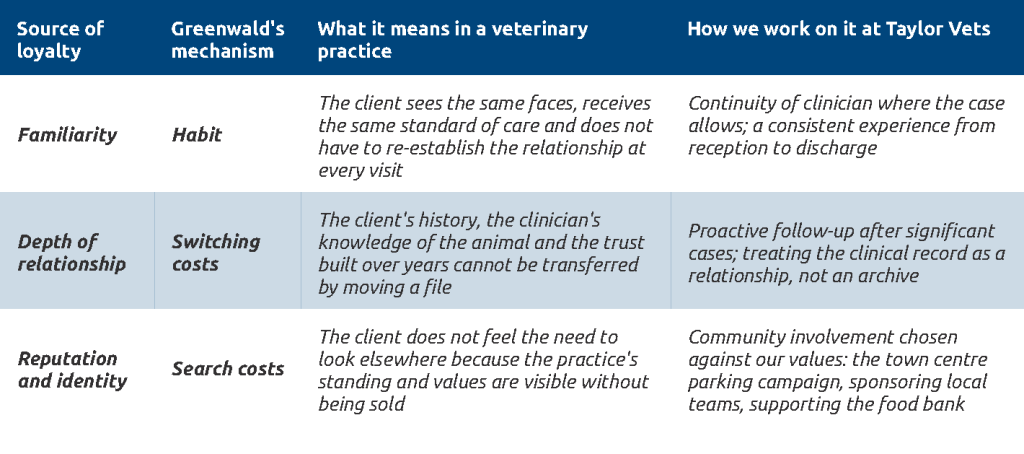
“Customer captivity” is not a phrase I would use in front of a client, but the mechanisms are real, and reframed as sources of loyalty they give a practice owner something concrete to work on.
One point needs stating plainly – the “cost of leaving” must never be engineered. Clients are entitled to a copy of their animal’s clinical history, to a written prescription and to a straightforward transfer if they choose to go. Anything that makes leaving harder rather than staying more attractive fails the test I apply to every decision: would I be comfortable if a client read about it? Depth of relationship is a consequence of doing the job well over time, not a lever to be pulled.
The third row is the one most practices under-invest in. A competitor can publish the same prices, offer the same services and recruit from the same pool. What cannot be replicated is the accumulated trust from thousands of small decisions consistent with what the practice says it stands for. Our involvement in the Brackley parking campaign does not affect us directly; we have our own car park. It has generated more goodwill than any advertising we have bought, because it was obviously not advertising.

The moat you did not dig
Greenwald explains why loyalty is valuable. Behavioural economics explains why practices have historically received so much of it for free, and why that gift is now being withdrawn.
The foundation is prospect theory.² People judge outcomes as gains or losses relative to a reference point, and losses weigh more heavily than equivalent gains.³ Three consequences matter for a practice:
- The endowment effect: clients value what they already hold above what they would pay to acquire it.⁴
- Status quo bias: offered the current arrangement or an alternative, people keep what they have, even if it was never chosen with care.⁵
- Ambiguity aversion: a known quantity is preferred to an unknown one.⁶
Together these describe the average veterinary client with some precision. The practice they first registered with when the puppy arrived is the reference point for the animal’s life; leaving is framed as a loss before any alternative is assessed, and the alternative is discounted because it is unfamiliar and largely untested.
The CMA found early in its investigation that pet owners tend not to shop around between practices and assume prices will be similar. That is usually read as a failure of transparency. It is equally consistent with clients who were not looking, because looking felt like the first step towards a loss.
The same asymmetry makes clients fragile once things go wrong. Bad experiences register as losses, and the psychological evidence is consistent that negative events carry more weight than positive ones of equal size, so one poor visit is not cancelled by one good visit; the ledger does not balance.⁷
Trust behaves the same way, built slowly and destroyed quickly, which Slovic termed the trust asymmetry principle.⁸ The peak-end rule adds that experiences are remembered by their most intense moment and their ending, not their average.⁹ A visit that was clinically excellent but ended in a dispute at the desk over an unexpected fee is remembered as the dispute.

Erosion, then, is a shift in the reference point. While the relationship is good, the reference point is “my practice” and leaving is the loss. Each poor experience moves it. After enough of them, the client’s endowment is no longer the practice but the grievance; staying becomes the loss and switching becomes the gain. Loss aversion changes sides. This is why departures so often appear sudden after years of apparent contentment: the client was not content, they were endowed, and the endowment was being quietly written down.
Hirschman observed that loyalty does not prevent exit; it delays it, and in the interval the client complains rather than leaves.¹⁰ A practice that treats complaints as nuisances is draining its moat at the moment it is being offered the chance to refill it.
Transparency completes the picture. The remedies remove the ambiguity component directly: the alternative will no longer be unknown, at least on price. That takes away one of the three props under default stickiness and leaves the practice resting on the other two, both of which depend on the relationship and are within its control. Every practice inherited a moat it did not dig. Transparency has lowered the water level, and every poor experience drains it further.
Measuring loyalty: four indicators
A framework is only useful if it can be tested. We use four measures, none of which requires software beyond what most practices already run.
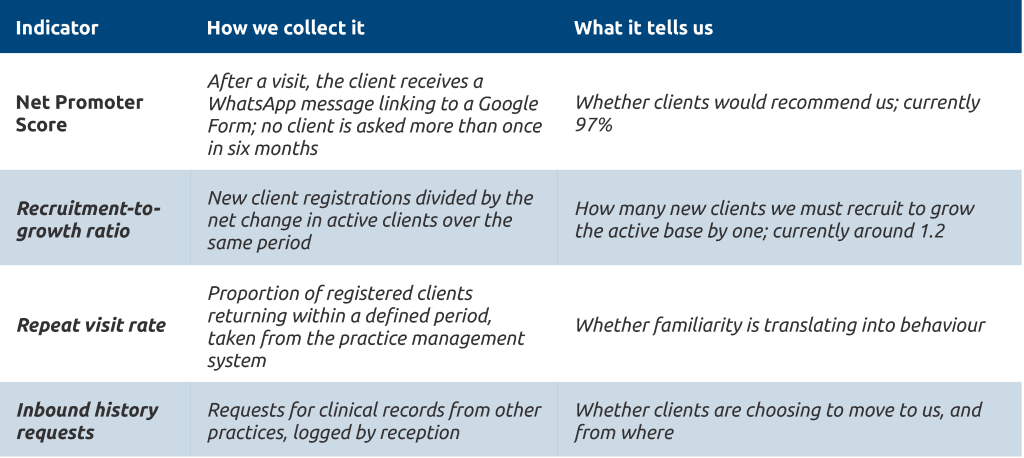
The recruitment-to-growth ratio deserves explanation: if a practice recruits 120 new clients and its active client count rises by 100, the ratio is 1.2: for every 1.2 clients recruited, one is net growth and the remainder replaces attrition. A ratio drifting upwards means the practice is working harder to stand still. Our figure tells me that retention, not acquisition, is the constraint on growth, which is exactly what the loyalty framework predicts. The history request log is the leading indicator: NPS tells you how clients feel; history requests tell you what they are doing.

The clients who do not answer
A 97% NPS describes the clients who replied. Non-response is not random: those who answer are disproportionately those with something to say. In Reichheld’s scheme, clients scoring 7 or 8 are “passives”; clients who never answer are passives in behaviour if not in score.¹¹ Jones and Sasser showed that in competitive markets satisfaction alone does not secure loyalty: completely satisfied customers are significantly more likely to repurchase than those who are merely satisfied.¹² The passive client has a low reference point: the practice is functional rather than endowed, there is little to lose by leaving, and transparency reduces it further.
Because they will not tell you, you must read them from the system. The signals are behavioural: vaccinations overdue beyond the expected interval; visits only when something is wrong; medication without consultation, or prescriptions requested for external pharmacies; estimates declined; no named clinician on the record; falling visit frequency in a long-registered client. None is conclusive alone. Together they define a segment the practice manager can extract quarterly in an hour.

Moving them follows from the psychology. Effort matters more than delight: reducing customer effort does more for loyalty than exceeding expectations.¹³ Online booking, a reply within the hour, one call rather than three and a named person to ask are the interventions for this group, and they cost less than anything designed to impress. The passive client also has no peak; every visit was fine. Create one deliberately, and because memory weights the ending, design how the visit closes at the desk as carefully as the consultation. Finally, invite voice directly: a short call from the client experience lead to ten passive clients a month, asking one open question, yields more than a hundred survey responses and creates the peak in the process. Ambassadors are then made by being asked. A client who has just experienced a peak will leave a review if the request comes at that moment, from the person who created it, not in a generic message a week later.
Results
Across 2025 to 2026 the group grew by 40%. NPS stands at 97%. I include these figures with a caveat: growth over that period reflected acquisition as well as organic client gain, and I would not attribute it to loyalty work alone. What I can say is that the recruitment-to-growth ratio, repeat visit rate and inbound history requests all moved in the direction the framework predicts, and that nobody in the practice now has to defend a fee they cannot show.
Implementation: a practice-level plan

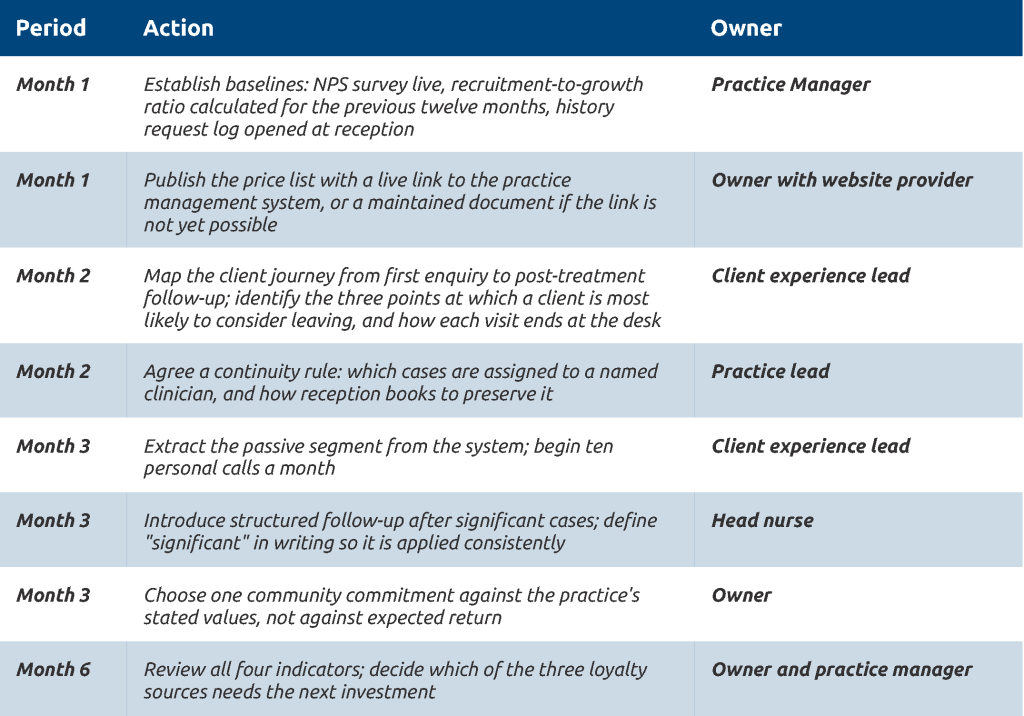
The work divides naturally by role. The practice manager owns the measurement; the client experience lead owns the journey; the practice lead owns continuity; the owner owns the values and the community commitments.
Common failure points
Loyalty schemes that read as inducements
Discounts for staying are a price decision wearing a loyalty costume. They train clients to value the discount rather than the practice, and they are the first thing a competitor can match. If a scheme would embarrass you in a CMA submission, it is not building loyalty.
Mistaking friction for depth
A practice that is slow to release records or awkward about prescriptions may retain clients in the short term. It also converts every departing client into a detractor, and it is indefensible if described to the client’s face. Depth is earned by the clinician who remembers the dog’s name; it is destroyed by the receptionist who makes the transfer difficult.
Treating complaints as noise
Hirschman’s point bears repeating: the complaining client is the loyal one. The complaint is the interval between endowment and exit, and it is the last moment at which the reference point can be moved back.¹⁰
Community activity chosen for visibility
Sponsorship selected because it will be seen is advertising, and clients can tell. The parking campaign worked because it cost us something and gained us nothing directly. Choose commitments you would make if nobody noticed.
Your starting point
Week 1 – Calculate your recruitment-to-growth ratio for the last twelve months. It requires two numbers from the practice management system and will take an afternoon.
Week 2 – Set up the NPS survey. A WhatsApp template and a Google Form are sufficient. Decide the frequency limit before the first message goes out.
Week 3- Ask reception to log every request for clinical history from another practice, with the source. Do nothing with the data yet; simply start collecting it.
Month 1 – Sit with the client experience lead and answer one question honestly: if a client compared our prices with the practice down the road and found us more expensive, what would we say? If the answer is not immediate, that is the work.
Conclusion
Transparency removes the last place a practice can hide. That is a threat only to practices that were hiding. For the rest, it is an invitation to say plainly what they have earned: a consistent team, a relationship that cannot be transferred by moving a file, and a reputation built through decisions never meant to be seen. The CMA has made price comparable. It has not made trust comparable, and it cannot. Every practice was handed a moat it did not dig. Those that stop relying on it and start refilling it will find that the age of comparison favours them.
Discover more in this series:
From strategy to traction: How OKRs and structured delegation can transform a veterinary practice
Beyond the consulting room: Strategic planning for veterinary practice owners
The price is right: Strategic pricing for the age of transparency
More about the author:
Dr John Taylor, MA VetMB MRCVS, Founder, Director and Veterinary Surgeon – Taylor Vets
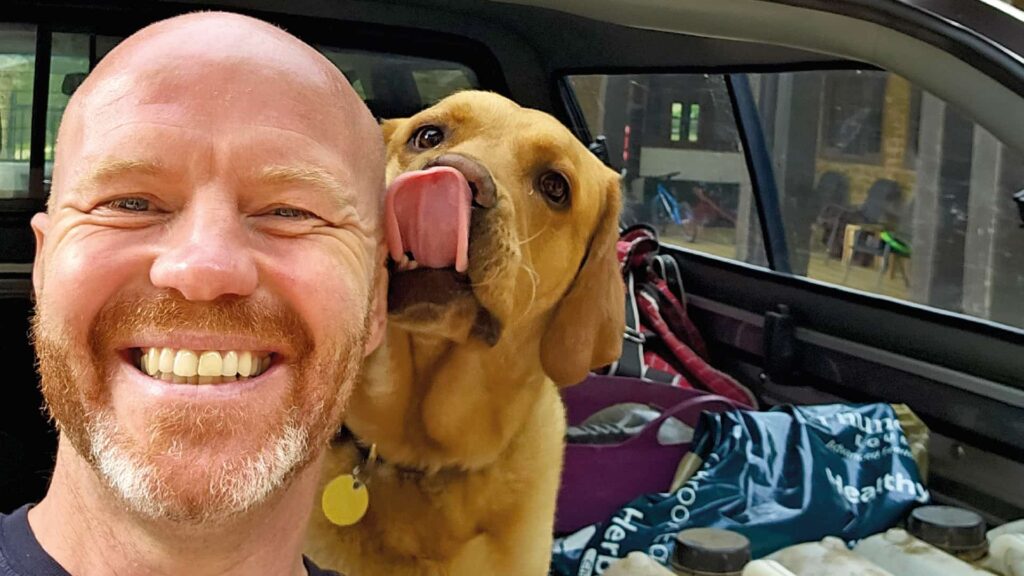
Dr John Taylor qualified from Cambridge University as a vet in 2000 and joined the Royal Army Veterinary Corps. In 2005 he set up a veterinary practice in Middleton Cheney, and since 2019 has been helping other practices to develop their clinical standards as well helping with more advanced surgical procedures.
He is a keen runner and cyclist and has competed in various endurance and Ironman races. He enjoys horse riding, and is currently about to learn how to start driving my horse Atlas. He’s married to Angela and has two boys, Michael and Joe.
This article was originally posted in the Autumn edition of The Cube magazine. Click here to read – https://nvsgroup.turtl.co/story/the-cube-autum-2026-public-version/page/1