

By Dr John Taylor, MA VetMB MRCVS, Founder, Director and Veterinary Surgeon – Taylor Vets
I have been thinking about pricing for twenty years. Not well, not consistently, and certainly not strategically; but the question of what to charge has nagged at me since I first opened a consulting room door as a practice owner.
In the early years, I did what most of us do. I inherited a fee schedule from a colleague, added a percentage each year that felt defensible, and benchmarked loosely against what the practice down the road seemed to charge. This is cost-plus pricing in its simplest form: take what it costs, add a margin, hope for the best.
My margins followed a hierarchy that will be familiar to every practice owner: prescription medications carried the highest markup, diets and supplements sat in the middle, and retail products carried the least. Nobody had ever explained why; it was simply how things were done.
Over time, my approach evolved. I began segmenting services, charging more for complex consultations and accepting lower margins on routine preventive work. When I sold my first practice and started Taylor Vets, I had the rare opportunity to build a fee structure from scratch, informed by both the mistakes I had made and the business education I was now pursuing.
The result is a pricing philosophy I am still refining, but one that rests on a principle I wish I had understood from the outset: the best pricing is fair pricing, and fair pricing is sustainable pricing.
That principle matters more now than ever. The CMA’s final remedies will require every UK practice to publish standardised price lists, provide itemised bills and feed pricing data into a national comparison tool by late 2027. But the CMA is not the reason to rethink pricing. The reason is that intelligent, transparent pricing is the single most powerful lever any practice owner has to increase revenue, strengthen client relationships and build a practice that is genuinely sustainable for clients, staff and owners alike.

Why cost-plus fails
Cost-plus pricing treats every client as identical and every service as interchangeable. A single consultation fee means you are simultaneously too high for the price-sensitive client coming for a booster and too low for the client who would happily pay more for a longer appointment with a certificate holder.
Economists call this gap “consumer surplus,” and cost-plus leaves it entirely untouched.
A Cranfield MBA simulation demonstrated the scale of the problem. Twenty-four customer profiles with different incomes and motivations were presented with three approaches: average pricing, segmented pricing and dynamic pricing. Moving from average to segmented pricing increased total revenue by over 30%, with no change to the product or the costs. The only variable was how intelligently the price matched the customer’s perception of value.
I want to be clear about what “capturing value” means in this context. It does not mean extracting the maximum possible price from every interaction. It means aligning price with the genuine value delivered, so that clients feel they are paying fairly and the practice earns a margin that sustains excellent care. A practice that consistently undercharges will eventually cut corners on staffing, equipment or consultation time. A practice that overcharges will lose trust and, eventually, clients.

Understanding what your clients actually value
Consider a thought experiment. What is the Mona Lisa worth? Price it on a cost-plus basis and you arrive at a few pounds of poplar panel, some linseed oil and a handful of mineral pigments. Call it a few hundred pounds, generously.
Yet the painting is insured for approximately £700 million, because its value has nothing to do with the cost of its inputs. Its value is determined by what it means to the people who experience it: its rarity, its significance and the trust placed in its authenticity.
Veterinary practice is not the Louvre, but the principle holds. Clients are not paying for the cost of a consulting room, a stethoscope and fifteen minutes of a veterinary surgeon’s time. They are paying for reassurance, expertise, relief and a relationship of trust.
Value-based pricing starts from this reality rather than from a spreadsheet of overhead cost allocations.
A useful framework distinguishes between hygiene factors and motivators:
Hygiene factors – baseline expectations that will not win business but whose absence will lose it.
Hygiene factors should be priced competitively; there is no sustainable premium to be extracted from meeting baseline expectations.
Motivators – the reasons a client chooses you over the alternative.
Motivators can command a fair premium, because they represent the basis on which the client made their choice.
When I mapped this against Taylor Vets, the results challenged several assumptions. Things I had considered differentiators turned out to be hygiene factors that every competent practice offers.
Meanwhile, things I had never thought to price for emerged as genuine motivators: same-day urgent appointments, continuity of care with a named vet, proactive post-operative check-in calls, and the ability to speak to a clinician when anxious about a pet. These create real value for the client, cost relatively little to deliver, yet appeared nowhere in my fee structure.

Stop pricing by product type; start pricing by substitutability
The traditional markup hierarchy is a relic of a world without online pharmacies. Prescription medications carried the highest margin because the practice controlled supply, and the client did not know the wholesale cost. The CMA has demolished that asymmetry: its investigation found common medications cost 50 to 60% less online, and new rules will require practices to tell clients that written prescriptions are available.
The replacement framework is simpler and more honest: price according to how easily the client can obtain the product or service elsewhere.
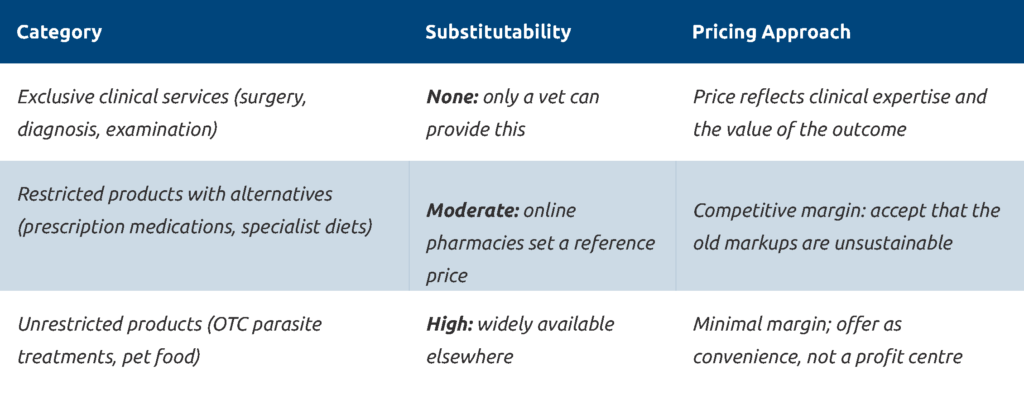
This reframing changes how you think about common practices such as injection fees. Many practices charge a separate administration fee on top of a medication markup. From a cost-plus perspective, this makes sense; there is a genuine cost to the syringe, the nurse’s time and clinical waste. From a value-based perspective, the pricing power sits in the clinical act itself, not in the product being injected.
A practice that charges a transparent, inclusive professional service fee for vaccination is communicating the value of clinical expertise. A practice that itemises product, injection fee and consultation fee is presenting a chain of costs, each of which invites comparison and scrutiny.
The broader principle: as transparency exposes product margins, the practices that prosper will be those that shift their revenue centre of gravity from products anyone can sell to services only a qualified team can deliver.
The trust cost of getting pricing wrong
Kahneman, Knetsch and Thaler’s research on pricing fairness established a principle that should inform every fee decision: customers accept price increases driven by genuine cost pressures, but reject increases that appear to exploit demand or the customer’s lack of alternatives.
The emergency consultation fee is acceptable when it reflects real out-of-hours costs; it becomes problematic when it appears to exploit the client’s emotional vulnerability. The medication markup is defensible when it covers clinical oversight and convenience; it becomes indefensible when the same product is available online for 60% less, and the client was never told.
The long-term cost of exploitative pricing is not hypothetical. Dignity plc, the UK’s largest funeral provider, saw its EBITDA margin halve after the CMA’s funeral investigation exposed premium pricing that clients could not reconcile with the service received. The company was taken private in 2023 after years of declining share. Dignity did not fail because its prices were published; it failed because once they were, clients could see the premium bore no relationship to the value delivered. Pricing that depends on the client not knowing any better was always going to crumble.

Bundling: shifting from transactions to relationships
Mandatory itemised billing will shift pricing power toward clients who can compare each line item against competitors. The strategic response is to create voluntary bundles that shift the unit of comparison from the transaction to the relationship.
Wellness plans are the mechanism. Denplan, the dental capitation scheme, now covers over 1.5 million patients with extraordinary retention. Veterinary equivalents are growing rapidly, with plan members spending approximately 37% more annually than non-members and showing 38% higher retention.
The behavioural economics are clear: a £25 monthly direct debit sits in the “subscription” mental account; a £300 invoice sits in the “unexpected expense” account. For the client, this is genuinely a better experience. For the practice, it creates predictable revenue and a relationship rather than a series of transactions.
Every tier must deliver genuine value at its price point. A plan designed to lock clients into spending more than they otherwise would is a trap, and clients will recognise it. The best plans create a genuine alignment of interests: predictable costs and comprehensive preventive care for the client; predictable revenue and healthier patients for the practice.
Pricing as a values decision
Pricing is not separate from care; it is an expression of it. A practice that prices fairly can afford to invest in staff, equipment and time. A practice that prices carelessly, whether too low to sustain quality or too high to sustain trust, will eventually compromise on all three.
The practices that will thrive in the age of transparency are not the cheapest and not the most expensive. They are the ones whose prices make sense: to the client, to the team, and to the long-term health of the business. Fair pricing, honestly communicated, within a relationship built on trust. That is the price that is right.

How to: Your starting point
#1. Audit your current pricing against actual costs for your ten most common services.
You will discover services delivered at a loss and others where your margin is higher than you realised. That information ensures your pricing can survive a fairness test.
#2. Publish your prices voluntarily, now.
Evidence from the SRA’s legal services transparency rules shows early adopters maintained market share advantages that reluctant compliers could not replicate. Structure your price page as a menu with descriptions, not a bare list of numbers.
#3. Map your products and services against the substitutability spectrum.
Build your fee structure outward from the irreplaceable clinical expertise that no online pharmacy can replicate, rather than inward from product markups that transparency is about to erode.
More about the author:
Dr John Taylor, MA VetMB MRCVS, Founder, Director and Veterinary Surgeon – Taylor Vets

Dr John Taylor qualified from Cambridge University as a vet in 2000 and joined the Royal Army Veterinary Corps. In 2005 he set up a veterinary practice in Middleton Cheney, and since 2019 has been helping other practices to develop their clinical standards as well helping with more advanced surgical procedures.
He is a keen runner and cyclist and has competed in various endurance and Ironman races. He enjoys horse riding, and is currently about to learn how to start driving my horse Atlas. He’s married to Angela and has two boys, Michael and Joe.
The article was originally posted in The Cube magazine, June 2026 issue. Click here to read the magazine.