
Role of Adsorbents
Adsorbents work by binding an unwanted substance in the gut to reduce the amount available for absorption onto the system. The bound substance then travels through the gut an is excreted in the faeces. In some instances, repeat dosing is required to combat the entero-hepatic recirculation, which results in the substance re-entering the gut through the bile. It is important to be aware that not all adsorbents will bind to all toxins and understanding the nature of the toxin is important when choosing the correct binder to use.
Charcoal or Diosmectite?
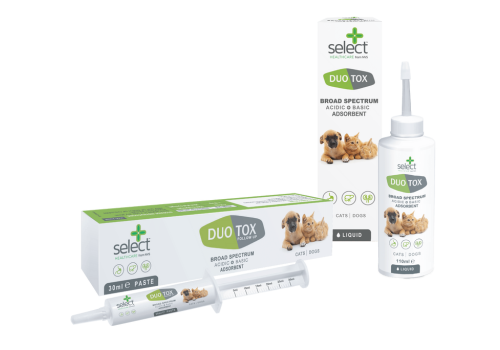
While activated charcoal plays an important role in cases of many toxin ingestions, there are some situations where it is ineffective. For these moments, when the owner is unsure of the toxin, or in cases when the vet is unsure if the toxin is acidic or alkaline in nature, using a broad spectrum binder such as Duotox is beneficial. While activated charcoal binds acidic substances and those that are poorly water soluble, disomectite is more effective for alkaline and hydrophilic toxins. Duotox contains both activated charcoal and disomectite for complete coverage, making it an ideal product to reach for in cases involving unknown toxins.
Explore more from Digestive Health
Toxins and the role of activated charcoal
Toxin ingestion is one of the most common emergency presentations in veterinary practice and cases can range from mild to life-threatening within a matter of hours.

Managing cases of diarrhoea
Gastrointestinal disorders are another highly seen condition, with the prevalence of enteropathies in dogs reported to be 10% and in cats approximately 8.5%.
Toxins and the role of activated charcoal
Toxin ingestion is one of the most common emergency presentations in veterinary practice and cases can range from mild to life-threatening within a matter of hours.
Managing cases of diarrhoea
Gastrointestinal disorders are another highly seen condition, with the prevalence of enteropathies in dogs reported to be 10% and in cats approximately 8.5%.