
A practical guide to turning strategic vision into operational reality
By Dr John Taylor, MA VetMB MRCVS, Founder, Director and Veterinary Surgeon – Taylor Vets
Eighteen months ago, I had a strategy. Like most veterinary practice owners, I could articulate exactly where I wanted my practice to be: excellent clinical outcomes, engaged team, satisfied clients, sustainable growth. What I lacked was traction, the ability to translate that strategy into daily operations that actually moved us forward.
The gap between strategy and execution is where most veterinary practices fail. We create beautiful vision statements, then return to the same chaotic daily operations, wondering why nothing changes. The bridge between strategy and results isn’t motivation or harder work, we need systematic implementation through OKRs (Objectives and Key Results) and structured delegation, tracked with the rigour we apply to clinical cases.
The strategy-execution gap
Strategic visions are usually clear e.g. “Build a practice where clinical excellence is enabled by operational excellence.” Inspiring? Perhaps. Actionable? Not remotely.
Strategy without an execution mechanism is merely aspiration. I needed to transform abstract strategy into concrete actions that my team could execute daily. This required three elements working in concert: OKRs to define success, delegation to distribute execution, and tracking to maintain accountability.
The revelation came when I recognised that running a practice required the same systematic approach as managing a complex medical case. You wouldn’t treat diabetes without monitoring blood glucose, adjusting insulin, and tracking outcomes. Yet I was trying to run a practice without equivalent management systems.

OKRs: Making strategy measurable
Objectives and Key Results (OKRs) transformed my vague strategy into specific, measurable targets. The framework is simple: Objectives define where you’re going (qualitative), Key Results measure how you’ll know you’ve arrived (quantitative).
My strategic vision translated into quarterly OKRs:
Q1 Objective: Create sustainable operational systems that free clinical time
Key Results:
- Reduce average consultation overrun from 8 minutes to 3 minutes
- Decrease total weekly overtime from 15 hours to 5 hours
- Increase clinical time percentage from 30% to 50% of my working hours
- Maintain client satisfaction above 4.5/5.0 throughout changes
The specificity mattered. “Improve efficiency” means nothing. “Reduce consultation overrun to 3 minutes” creates clear targets that everyone understands.
Setting Effective OKRs:
I learned three critical principles:
First, involve the team in setting Key Results. When our head receptionist suggested tracking consultation overruns, she revealed a problem I hadn’t recognised. Team involvement surfaces real operational issues rather than perceived ones.
Second, limit scope ruthlessly. Three to four Objectives per quarter, with three to four Key Results each. More than this creates confusion rather than clarity. When everything is a priority, nothing is.
Third, make Key Results binary: either you achieved them or you didn’t. “Improve efficiency” allows endless debate. “Reduce overtime to 5 hours weekly” is unambiguous.
From OKRs to delegation: The missing link
OKRs revealed what needed achieving, but not who would achieve it. Initially, I tried to drive all Key Results myself, which simply added to my workload. The breakthrough came when I mapped each Key Result to specific delegated responsibilities using a RACI matrix.

The RACI matrix clarifies four critical roles for each task:
- Responsible: Who actually does the work
- Accountable: Who owns the outcome (only one person)
- Consulted: Who provides input before decisions
- Informed: Who needs updates on progress
For example, reducing consultation overruns broke down like this:
Appointment scheduling optimisation:
- Responsible: Practice manager
- Accountable: Practice manager
- Consulted: Reception team, clinical staff
- Informed: Myself, head nurse
Simplified delegation: The three-Step framework
I abandoned complex delegation theories for a simple three-step process – see table below.
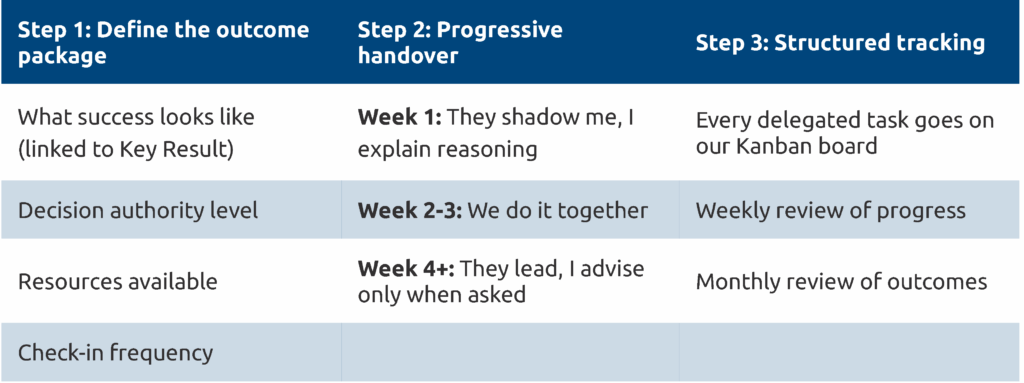
The simplicity was crucial. Complex frameworks create resistance; this simple structure enabled action.
The Kanban board: Making work visible
The transformation accelerated when I implemented a Kanban board, a visual workflow management system originally developed in Japanese manufacturing, which shows work moving through different stages. Think of it as a visual pipeline where tasks flow from “to do” through “doing” to “done”, making it immediately obvious where work is accumulating or stalling.
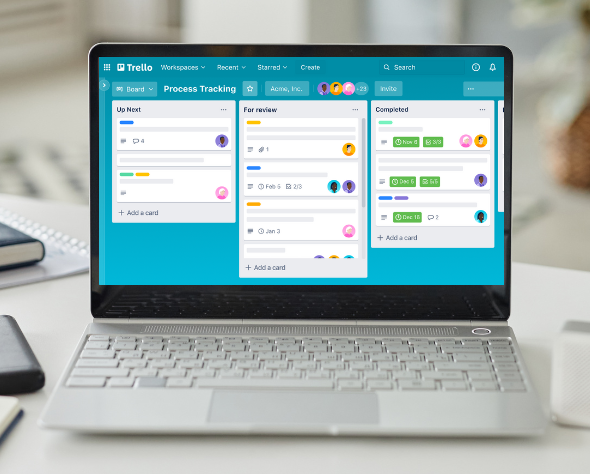
I used Trello, a free web-based tool that creates digital Kanban boards. Trello works like a virtual whiteboard with columns (called “lists”) containing cards that you can drag from column to column as work progresses. Each card can hold detailed information, checklists, due dates, and assigned team members. The beauty of Trello is that everyone can access it from any device, updates happen in real-time, and the visual nature means you can understand the entire workflow at a glance.
Invisible work can’t be managed effectively. Our board made delegated tasks visible to everyone.
Our Board Structure:
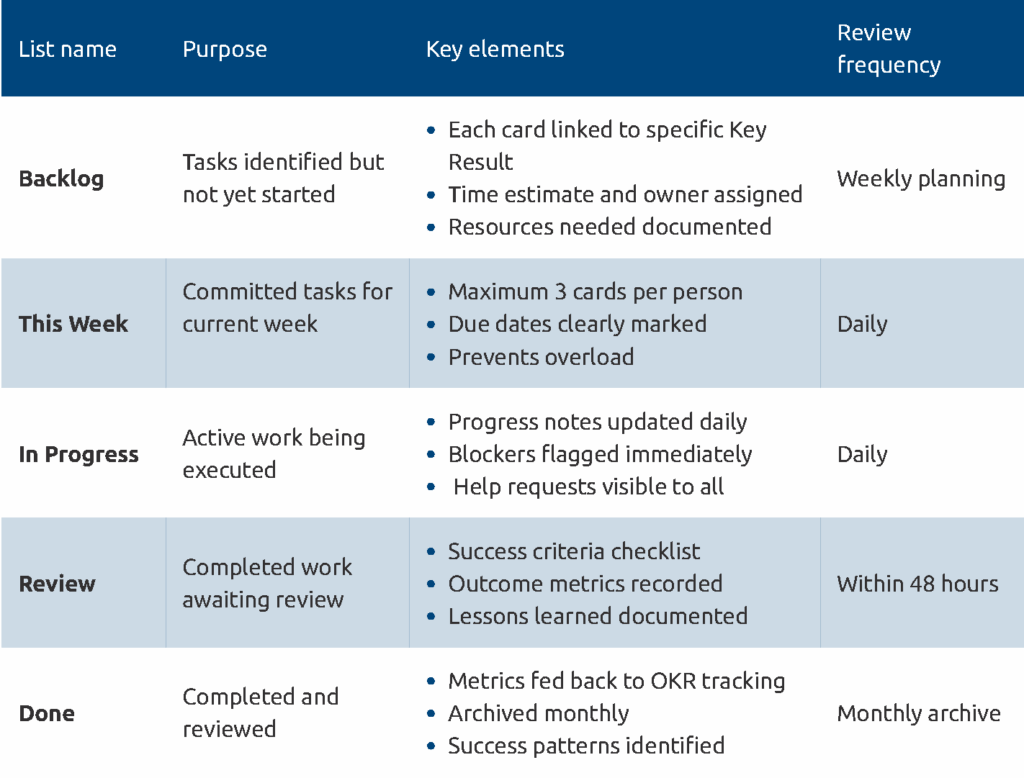
Critical Rules:
- Every delegated task must have a card; no invisible work
- Cards move left to right only (no backward movement without discussion)
- Work-in-progress limits enforced (max. 2 cards per person in “In Progress”)
- Daily board review at morning huddle (2 minutes maximum)
This visibility transforms accountability.
The daily and weekly rhythms
Structure without rhythm fails. We established simple, non-negotiable rhythms:
Daily (10 minutes, standing):
- Review Kanban board movements
- Identify blockers
- Confirm today’s priorities
- No problem-solving (flag for later)
Weekly (30 minutes):
- Review OKR progress (are we on track?)
- Move cards from Backlog to This Week
- Celebrate completed work
- Identify next week’s delegation opportunities
Monthly (60 minutes):
- Deep dive on OKR metrics
- Retrospective on delegation successes/failures
- Adjust delegation levels based on performance
- Plan next month’s focus areas
The brevity mattered. Long meetings killed momentum; these short, focused sessions maintained energy whilst ensuring accountability.
Delegation levels: The clarity tool
I eliminated delegation confusion by defining five clear levels – see table below.
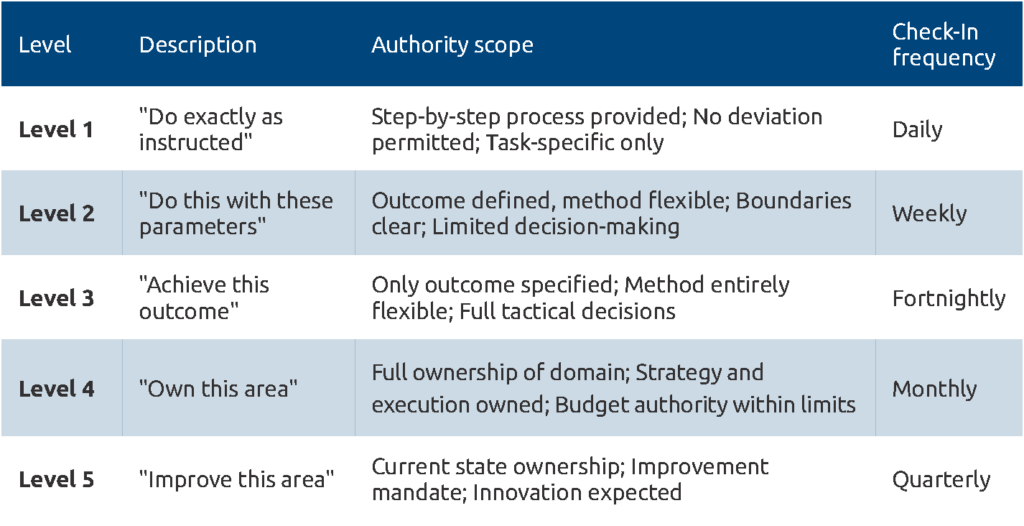
Every Kanban card shows its delegation level. This eliminated the constant questions about authority and the fear of overstepping. Our administrator knew that her social media work was Level 4; she owned it completely within brand guidelines.
Measuring traction: The proof points
After six months, the system’s impact was measurable:
OKR Achievement:
- Q1: 60% of Key Results achieved (learning quarter)
- Q2: 75% achieved (system maturing)
- Q3: 85% achieved (full traction)
Delegation Metrics:
- Tasks delegated: Increased from 5 to 47
- Average delegation level: Rose from 1.5 to 3.2
- Delegation cycle time: Reduced from 8 weeks to 3 weeks
Practice Outcomes:
- My clinical time: Increased from 30% to 65%
- Staff overtime: Reduced by 56%
The Multiplier Effect:
Each successful delegation created capacity for more delegation. As team members progressed to higher delegation levels, they began delegating to others. The practice operates as a system, not a hub-and-spoke around me.
Common failure points and solutions
Failure: OKRs disconnected from daily work
Solution: Every task on the Kanban board must link to a Key Result. No link, no task.
Failure: Delegation without tracking
Solution: Nothing is delegated unless it’s on the board. Verbal delegation is banned.
Failure: Review meetings become problem-solving sessions.
Solution: Strict agenda. Problem-solving happens outside review meetings.
Failure: Too many concurrent delegations
Solution: Work-in-progress limits. New delegation only when previous one reaches Level 3.
Failure: Unclear authority levels
Solution: Delegation level visible on every card. When in doubt, ask before acting.
The technology stack that works
Keep it simple:
- Trello for Kanban boards (free version sufficient)
- Google Sheets for OKR tracking (simple dashboard)
- WhatsApp for urgent escalations only
- Physical whiteboard for daily huddle focus
We tried complex project management software, but it failed. Simplicity drives adoption; complexity kills it.
Starting tomorrow: Your implementation path
Week 1: Create your first OKR
- Pick one operational pain point
- Define one Objective with 3 Key Results
- Share with your team for input
- Finalise and communicate
Week 2: Set up your Kanban board
- Create the five lists in Trello
- Add 3-5 tasks from your Key Results
- Assign owners and delegation levels
- Make it visible to everyone
Week 3: Establish daily rhythm
- Start daily 10-minute huddles
- Review board movement only
- No problem-solving in huddle
- Build the habit before perfecting it
Week 4: Delegate one task
- Choose something you do weekly
- Define outcome and delegation level
- Create Kanban card
- Begin progressive handover
Month 2: Scale and refine
- Add second OKR
- Increase delegation targets
- Refine board categories
- Measure first metrics
Month 3: Full Implementation
- Complete OKR set for quarter
- All regular tasks on board
- Weekly and monthly rhythms established
- First quarterly review conducted
The fundamental shift
The journey from strategy to traction isn’t about working harder; it’s about working systematically. OKRs translate strategy into measurable outcomes. Delegation distributes execution across capable team members. Kanban boards make work visible and trackable. Together, they create traction.
The shift requires accepting three truths:
- You cannot execute strategy alone. There aren’t enough hours.
- Delegation without structure fails. Good intentions evaporate under daily pressure unless systems enforce them.
- Invisible work can’t be managed. If it’s not on the board, it doesn’t exist.
The competitive reality
Practices fall into two categories: those with systems and those without. The gap widens daily. Systematic practices improve continuously whilst chaotic practices just survive.
In eighteen months, we’ve transformed from mild chaos to clarity. My clinical time doubled. Team satisfaction increased dramatically. Practice revenue grew without adding hours.
But the real transformation was psychological. I stopped being the bottleneck. The team stopped waiting for my decisions. The practice became a system that functions excellently whether I’m in surgery, on holiday, or writing this article.
The path from strategy to traction is clear: Define success through OKRs. Distribute execution through structured delegation. Track everything visibly. Maintain rhythm religiously. The only question is whether you’ll start tomorrow or continue hoping that harder work will somehow produce different results.
Start tomorrow. Your future self will thank you.
More about the author:
Dr John Taylor, MA VetMB MRCVS, Founder, Director and Veterinary Surgeon – Taylor Vets

Dr John Taylor qualified from Cambridge University as a vet in 2000 and joined the Royal Army Veterinary Corps. In 2005 he set up a veterinary practice in Middleton Cheney, and since 2019 has been helping other practices to develop their clinical standards as well helping with more advanced surgical procedures.
He is a keen runner and cyclist and has competed in various endurance and Ironman races. He enjoys horse riding, and is currently about to learn how to start driving my horse Atlas. He’s married to Angela and has two boys, Michael and Joe.
John is part of the New Practice Academy session at the London Vet Show 2025:
The Financial Truth About Starting a Vet Practice
20 November 2025, 3-3.50pm
Business Theatre
The article was originally posted in The Cube magazine, October 2025 issue. Click here to read the magazine.